


Your Google Business Profile description or (more famously known as) Google My Business (GMB) description isn’t just a few lines about your business; it’s a vital tool in your SEO arsenal, your digital handshake with potential customers.
Now, let’s get this straight: crafting a killer GMB description isn’t just about stuffing it with keywords. It’s about strategically combining SEO savvy with a dash of your brand’s personality.
In this guide, we’ll walk through the process step-by-step, ensuring that by the end, your GMB description won’t just be good; it’ll be gold-standard.
In the digital marketplace, your GMB profile is often your first chance to make a lasting impression. Let’s make sure it’s a great one.
Section 1. Getting Started: Know Your Business Inside Out
1.1 Identifying Your Unique Selling Points (USPs)
Before you even type the first word of your GMB description, pause.
Ask yourself, “What makes my business stand out?”
It’s not just about what you do; it’s about why it matters. Your Unique Selling Points (USPs) are the heart of this answer.
Firstly, consider what you offer that your competitors don’t. How are your different from your competition? Exceptional customer service? Maybe an innovative approach to a traditional service? These are your USPs.
Consider running a fitness gym in Singapore, with a unique twist: your gym specialises in integrating cognitive fitness into physical workouts. This is your Unique Selling Proposition (USP).
1.2 Reflecting Your Brand’s Voice
This is how your business ‘speaks’ to your audience. It should be as unique as your USPs. Your brand voice could be friendly and conversational, professional and authoritative, or anything in between. The key is consistency.
Imagine your business as a person. How would they speak? What kind of language would they use? For instance, if your bakery has a warm, family-friendly vibe, your GMB description should feel like a chat over a cup of coffee.
On the other hand, if you’re positioning yourself as a gourmet, high-end bakery, your language might be more refined and sophisticated.
According to a study by Sprout Social, 40% of consumers say they want brands to connect with them (source: Sprout Social). That connection starts with how you communicate. Your GMB description is the perfect place to start that conversation.
Section 2: Key Components in Crafting Your GMB Description
2.1 Clear, Concise, and Compelling Language
First things first, clarity is king. Your GMB description needs to be straightforward. Why? Because you’ve got just a few seconds to grab attention. Keep it short and sweet, but also engaging.
Here’s the thing: Google typically shows only the first 250 characters of your description in the search results, so make those characters count.
Let’s say you run a bakery. Instead of just listing your products or services like “We sell cakes, bread, and pastries”, spice it up to “Delighting taste buds with our heavenly cakes, artisan bread, and scrumptious pastries.”
See the difference? It’s vivid, inviting, and straight to the point.
2.2 Incorporating Keywords Strategically
Keywords are your secret sauce, but overdoing it can spoil the broth. Google’s algorithms are smart and can smell keyword stuffing from a mile away. According to Moz, a natural integration of keywords is crucial.
For example, if you’re a plumber in Manchester, instead of repeating “plumber in Manchester” endlessly, weave it in naturally: “Your go-to Manchester plumber, providing 24/7 emergency services and reliable repairs.”
Remember, Google loves relevance. So, choose keywords that genuinely reflect your business. Use tools like Google Keyword Planner for insights on what your potential customers are searching for.
2.3 Highlighting Services and Products
This part is where you showcase why your product or service is the answer to their needs.
For instance, rather than saying “We offer digital marketing services”, specify what makes your service unique: “Elevate your brand with our tailored digital marketing solutions, specialising in SEO, social media management, and content creation.”
It’s not just about telling them what you have; it’s about showing them why they need it. Remember, every word counts, so make sure each one works hard to promote your business effectively.
Section 3: Engaging Your Audience
3.1 Techniques for Writing That Resonates
You’re starting a conversation with your potential customer. How do you do that? By understanding and then speaking directly to their needs and desires.
Understand Your Audience:
Who are they? What do they want? A recent study showed that personalised content leads to a 20% increase in sales opportunities.
So, get specific. If you run a bakery, don’t just say “We make cakes.” Say “We create customised birthday cakes that bring your child’s favourite characters to life.”
Use Their Language:
Avoid industry jargon. Speak in a language that resonates with them. If your audience is young and trendy, a casual, upbeat tone works wonders. For a more mature, professional clientele, a sophisticated, knowledgeable voice is key.
Tell a Story:
People love stories. They’re memorable and shareable. A quick anecdote about how your product or service solved a specific problem can turn your description from mundane to memorable.
3.2 Call to Action (CTA)
A Call to Action (CTA) is your closer, your “ask.” It’s what turns a reader into a customer.
Be Clear and Direct:
A CTA should be straightforward. “Book your appointment today” is far more effective than a vague “Contact us for more details.”
Create Urgency:
Phrases like “Limited offer” or “While supplies last” encourage immediate action. According to a recent survey, creating a sense of urgency can increase conversion rates by up to 332%.
Offer Value:
Make it worthwhile. “Sign up now and get a free consultation” is more appealing than just “Sign up now.”
Remember, your GMB description is more than just a placeholder. It’s an opportunity to connect and convert. Make every word count.
Section 4. Navigating SEO Considerations
4.1 Understanding Google’s Algorithm and GMB Rankings
Google’s algorithm prioritises relevance, distance, and prominence when determining your local ranking.
Relevance:
This is where your description plays a pivotal role. It’s not just about peppering it with keywords; it’s about making it as informative and relevant to your audience as possible.
Think about what your potential customers are searching for and how your business answers those queries.
Distance:
While you can’t control this aspect, ensure your business details are accurate. A misplaced pin on Google Maps can be the difference between being found and being overlooked.
Prominence:
This is influenced by your online reputation – think reviews, ratings, and SEO practices on your website.
A robust and positive online presence boosts your GMB profile’s prominence.
4.2 Keeping Your Description Fresh and Engaging
Did you know that regularly updated GMB profiles are perceived as more reliable by Google?
That’s right, keeping your description fresh isn’t just about engaging your audience; it’s about appeasing the algorithm too.
Stay Current:
Businesses evolve, and your GMB description should reflect that. Whether it’s a new service, an award, or a change in business hours, keep your profile up-to-date.
Engage with Trends:
Is there a new trend in your industry? Reflect it in your description. This not only shows that you’re in tune with the market but also helps in appearing relevant in searches.
Seasonal Updates:
Got a seasonal promotion or special event? Update your description to reflect these. It shows your audience (and Google) that you’re active and attentive.
Remember, a stagnant profile can be a red flag for both potential customers and Google’s algorithm.
Regular updates signal that your business is active and engaged, making your GMB profile more likely to rank higher in local searches.
Section 5. Common Pitfalls to Avoid
5.1 Over-promotional Language
When you’re passionate about your business, it’s natural to want to shout about your products or services from the rooftops.
Your GMB description isn’t a rooftop. It’s a conversation starter. It’s tempting to pack your description with superlatives and hard-sell tactics, but remember, subtlety is key.
Why Balance is Crucial:
A survey by HubSpot Customer Loyalty Statistics revealed that 81% of consumers trust the advice of friends and family over business advice.
This statistic highlights the importance of sounding more like a trusted advisor than a salesperson in your GMB description. You want to inform, not overwhelm.
How to Achieve It:
Start by outlining the benefits of your products or services rather than just their features.
For example, instead of saying “We sell high-quality woolen coats,” try “Keep warm and stylish this winter with our range of high-quality woolen coats.”
This approach not only promotes your product but also connects with the customer’s needs and emotions.
5.2 Avoiding Jargon
Jargon can create barriers, and the last thing you want is for your GMB description to be an impenetrable wall of industry speak.
The Power of Simplicity:
According to the Plain English Campaign, clear and concise communication is more likely to win business.
Your GMB description should be easily understood by everyone, not just those in your industry.
Practical Tip:
Put yourself in your customers’ shoes. Would someone outside your industry understand your description? If there’s any doubt, simplify it.
For instance, rather than saying “We specialise in artisanal confectionery techniques,” you might say “We craft handmade sweets and chocolates with care and tradition.”
Section 6. Measuring Success and Adjustments
6.1 Utilising GMB Insights
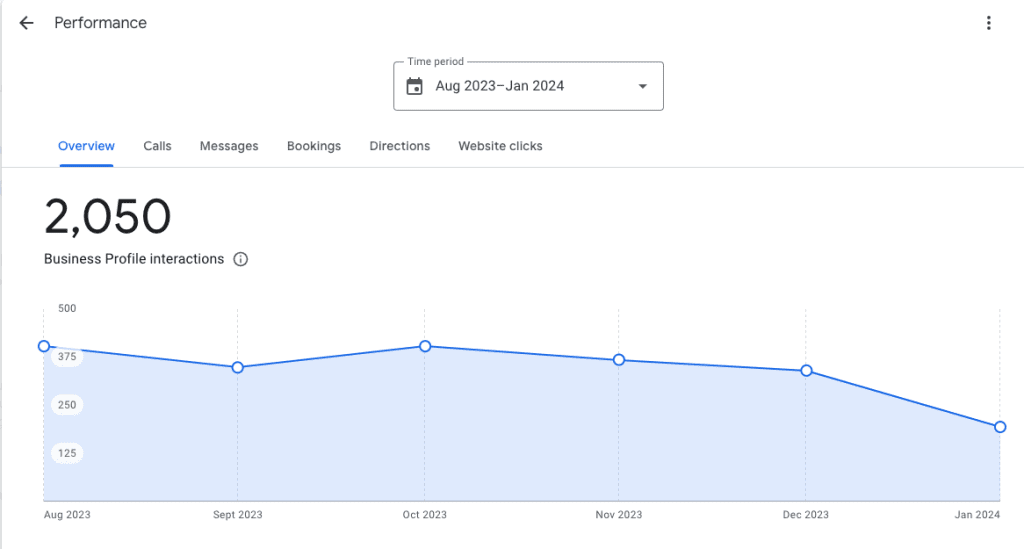
To really understand its impact, you’ll need to get cosy with Google My Business Insights. This tool is your window into how customers are interacting with your business online.
First off, access your GMB Insights. Look for metrics like ‘Performance’, scroll to the bottom right’ to see what search terms are bringing people to your profile.
If the keywords you’ve included in your description are doing their job, you’ll see them reflected here.
Also, pay attention to ‘How people discovered you’’ These tell you how often your profile pops up in searches and in map views, respectively.

The top bar is all the customer actions of how your customers interact once they found your profile – did they visit your website, call you, or check directions to your location? These actions are tangible indicators of your description’s effectiveness.
According to BrightLocal’s Local Consumer Review Survey, 87% of consumers used Google to evaluate local businesses in 2022.
6.2 Iterative Improvements
The key to a successful GMB description is to never set it and forget it. Regularly review the data from GMB Insights and listen to what it’s telling you.
If certain keywords aren’t performing, tweak them. If a particular service is getting a lot of attention, consider giving it more prominence in your description.
Customer feedback, both direct and indirect, is also a goldmine. Monitor reviews and messages for mentions of specific offerings or qualities of your business that people appreciate. This can guide you on what to highlight in your description.
For example, if you run a café and notice an uptick in comments about your fantastic vegan options, make sure your GMB description sings about this unique selling point.
And finally, stay on top of changes in your business or industry. If you’ve recently expanded your services, won an award, or shifted your focus, your GMB description should reflect this.
Keeping it updated and relevant is crucial for maintaining its effectiveness.
Conclusion
As we wrap up this guide, remember that mastering your Google My Business description is more than just a one-time effort; it’s an ongoing journey in the ever-evolving landscape of digital marketing.
Whether you’re tweaking a few words in your description, diving into the latest SEO strategies, or deciding when to call in the experts, every step you take is a stride towards your business’s online success.
Keep learning, stay adaptable, and don’t hesitate to seek help when needed. The digital marketing realm is vast, but with persistence and the right resources, you’ll navigate it like a pro.


